Understanding Motor Turns & Kv Rating
When you want to buy a new brushless motor for your r/c car, robot, or mechanical applications, have you ever been confused why the motors are interpreted by Turns (T) or by Kv rating?
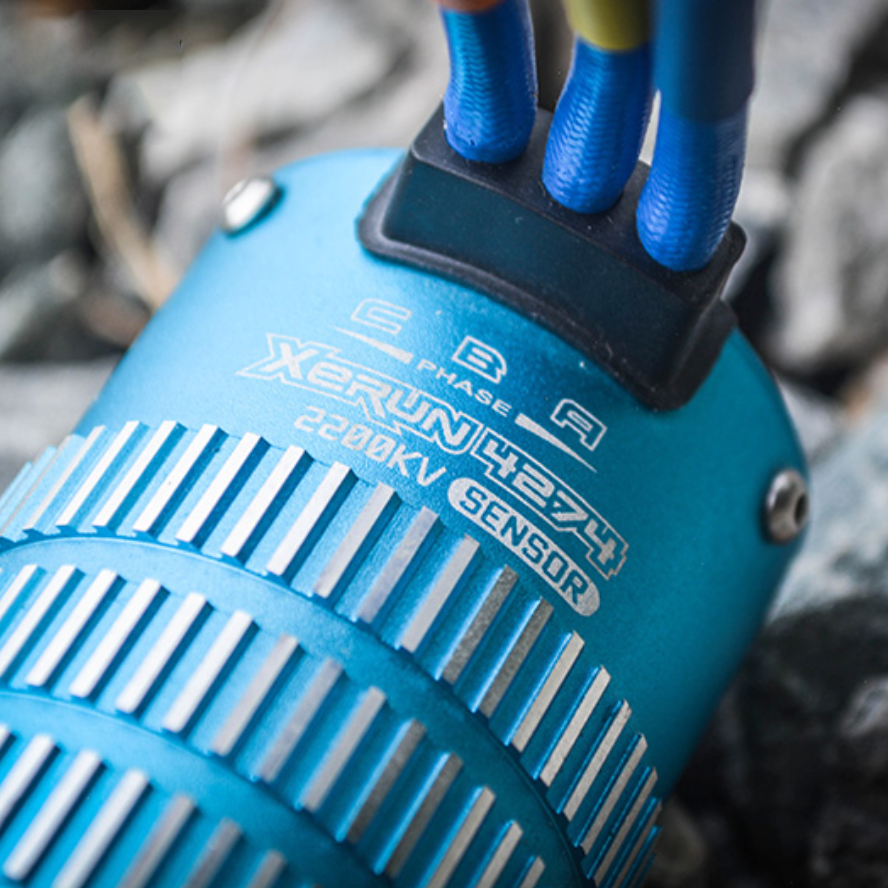
Today we are going to explain some basic information about Turns and Kv rating. What does Kv tell us? Well, it is related to the power out from a motor. Kv describes the RPM (revolutions per minute) a motor does per Volt that is put into it. Generally speaking the more Kv a motor has, the more RPM and more power. For example, a 9000Kv motor would be faster than a 2200Kv motor.
If Kv is like horsepower, then Turns is the physical attribute of a motor. The number of turns indicates how much wire is wrapped inside the motor. A higher turn number means more wire and thus more resistance, resulting in a slower motor. So turns with a lower number means a faster motor. The turn rating is inversely proportional to the power generated by the motor. Put simply, a 4.5T motor is faster than a 21.5T motor.
Now you need to make sure you choose the right Turn rating for your application. Using an R/C car as an example; lower T values, like 4.5T, will results in a much faster car, as the torque is lower but the Kv will be higher. Higher T values, like 27T, will be a higher torque, lower Kv motor. Crawlers would usually use a high T-rating motors, while touring cars and drift cars would go with low T-rating motors. Below gives you a general idea of the amount of Turns being generated to RPM:
So Kv and Turns are essentially the same: both are parameters for the motor. First you have to find out what you want. Powering a small, lightweight on-road car is definitely different from a heavy 1/8 scale off-road buggy or truck. What speed and runtime do you want to achieve? The above questions need to be answered before picking the correct motor.
Note: This article is a copyright of asiatees.com. For original article, please click HERE.
Related Posts
What is a Brake Dyno?

What is an Inertia Dyno?

What is Electromagnetic Interference (EMI)?
What is a Brushless Motor?
What is a Brushed Motor?
Inertia vs. Brake Dynos